I picked up Who Moved My Cheese? during one of those seasons in life where everything feels like it’s shifting beneath your feet — new pressures at work, uncertainty at home, and that nagging sense that the path I’d been walking had quietly disappeared. A friend pressed it into my hands and said, “Just read it. It’s short.” She was right on both counts.
What I didn’t expect was how much a children’s-parable-sized book would linger with me long after I turned the last page.
The Story Itself
Spencer Johnson gives us four characters living inside a maze, all searching for cheese — which, as you quickly understand, stands for whatever it is you want most in life. A career breakthrough. A loving relationship. A sense of purpose. The cheese is yours to define.
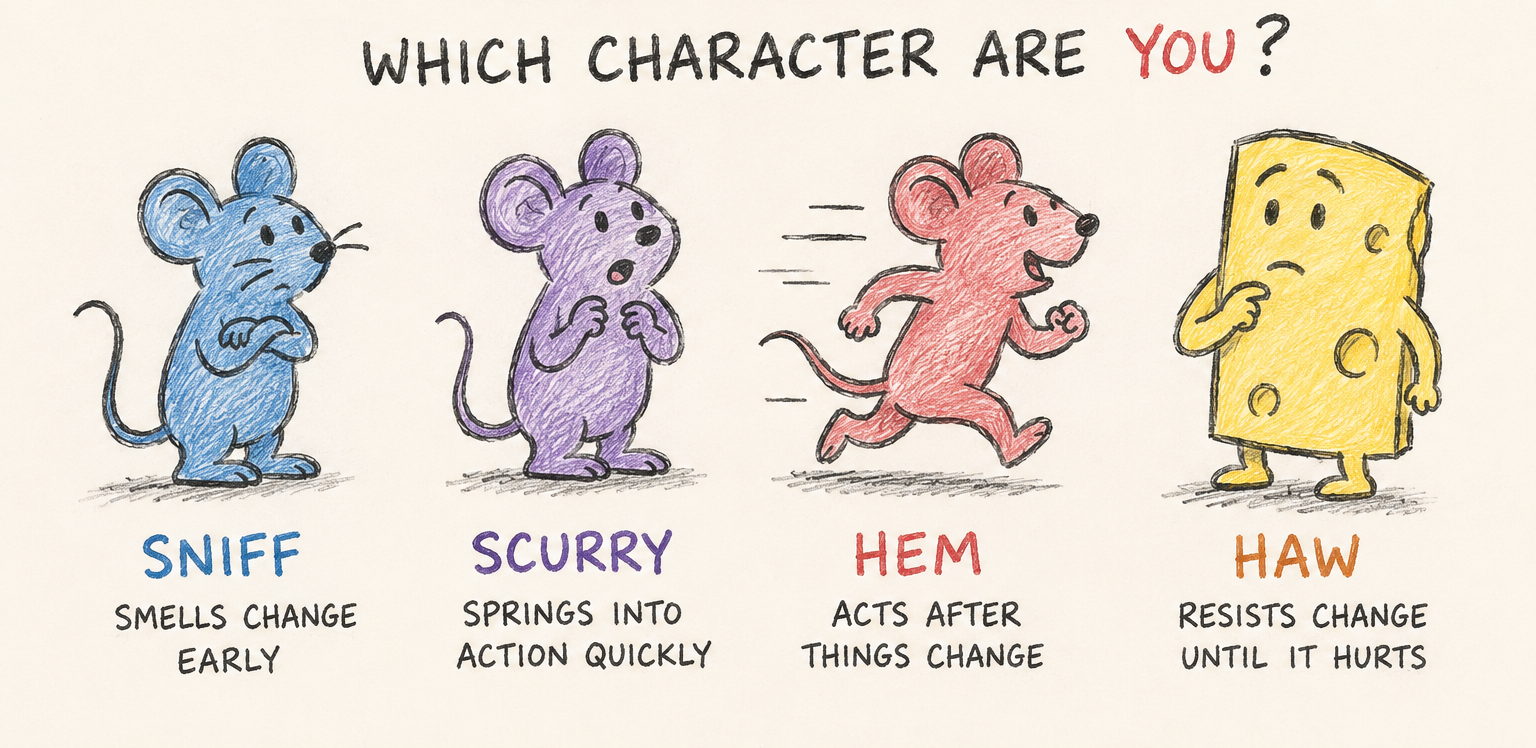
Two of the characters are mice: Sniff, who reads the room early and moves before change forces him to, and Scurry, who simply acts — no overthinking, no hesitation, just motion. The other two are little people: Hem, who digs his heels in when his cheese disappears, paralysed by fear and indignation, and Haw, who resists at first but eventually musters the courage to venture back into the maze and search again.
It’s almost embarrassingly simple. And yet, sitting there reading it, I caught myself.
I was Hem.
The Moment It Hit Me
There’s a scene where Hem, standing in an empty cheese station, keeps insisting the cheese will come back if he just waits long enough. He’d grown comfortable. He’d built his routines around that particular cheese, and losing it felt less like a problem to solve and more like an injustice to protest.
I laughed — the uncomfortable kind. Because I recognised exactly that feeling. The way we dress resistance up as patience. The way we call fear “being careful.” Johnson doesn’t let you hide from that. The maze, he’s telling you, doesn’t care about your feelings. The cheese moves. It always moves.
What I Carried Away
By the time Haw begins writing lessons on the maze walls as he walks — little reminders to himself, and to anyone who might follow — the book had stopped feeling like a business fable and started feeling personal.
A few things stayed with me:
Change doesn’t wait for you to be ready. Sniff and Scurry thrive not because they’re smarter, but because they stay alert. They never assume the cheese is permanent. That’s a discipline, not a personality trait.
Resistance is expensive. Hem doesn’t just fail to find new cheese — he suffers. He grows bitter and hungry while the maze sits full of possibilities he refuses to explore. Clinging to what was costs more than letting go.
Starting late is still starting. Haw’s journey is the emotional heart of the book. He’s frightened. He second-guesses himself. He even considers going back. But he keeps moving, and the moving itself begins to feel less terrifying the longer he does it. That felt true to me in a way I didn’t expect from a book I could read in an afternoon.
The Question It Left Me With
Johnson ends by nudging you to look at your own maze. What’s your cheese? Where are you standing right now — moving toward something new, or waiting in an empty room for something to return?
I’ve thought about that question more than once since I closed the book. There’s something quietly powerful about such a small story holding up a mirror that clearly.
The cheese will move. It already has, probably. The only real question is whether you’re ready to move with it.